

Molecular Modeling, Simulation & AI Drug Discovery Software
MolCube has been developing a global-leading computational platform to provide an ultimate solution for modeling and simulation of complex biomolecular and/or material systems that enables drug and material discovery.
Overview
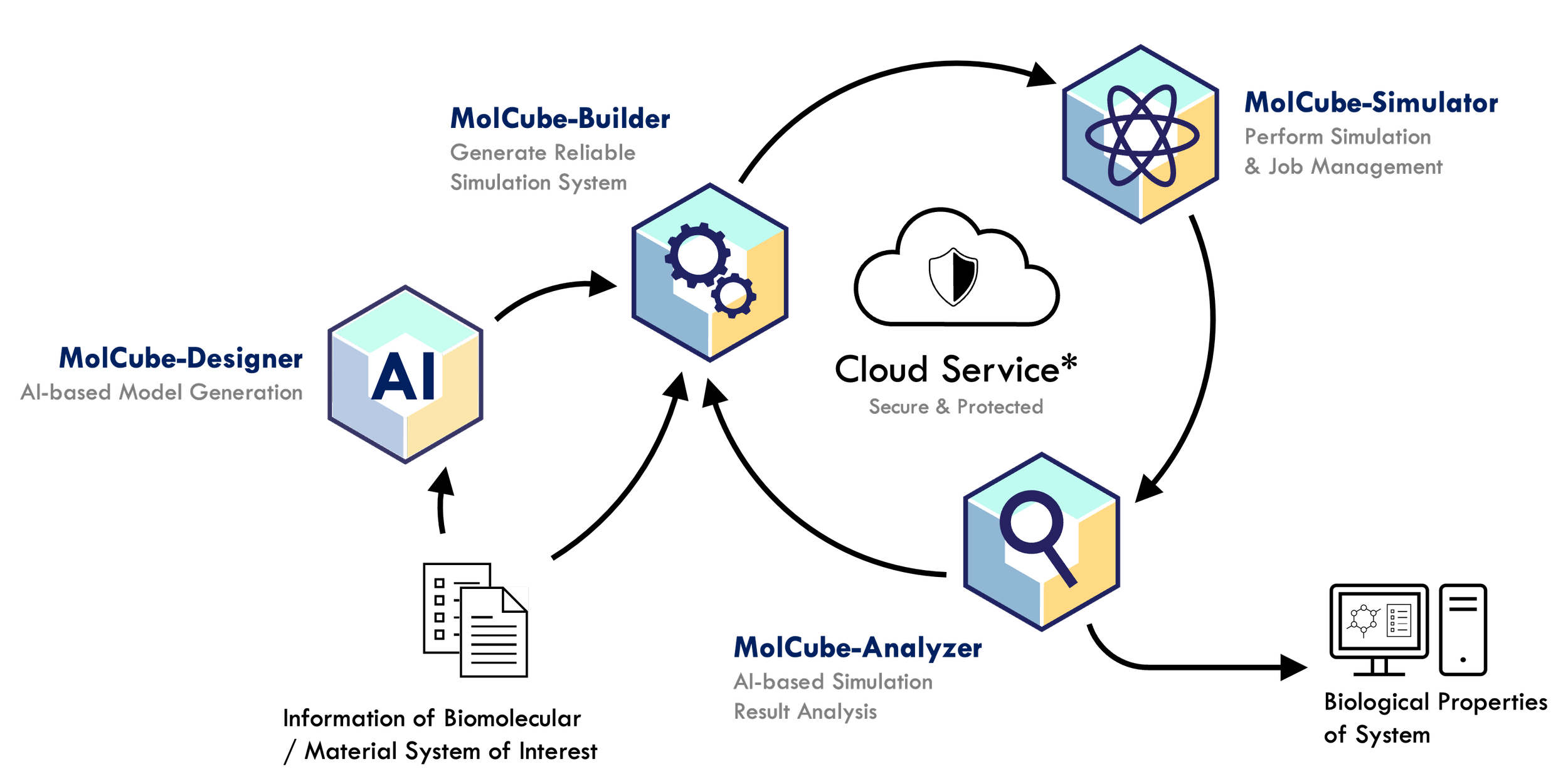

MolCube-Designer
MolCube-Designer is for AI-based model generation, automatically proposing and creating diverse molecular structures such as proteins, ligands, and complexes. It streamlines the design process, expands the scope of exploration, and helps researchers validate hypotheses more efficiently.

MolCube-Builder
MolCube-Builder is for complex model building and simulation input generation. MolCube-Builder does not require any commercial third-party software and will be available as a web server or can be installed locally or in your cloud system.

MolCube-Simulator
MolCube-Simulator is for job submission to designated cloud systems and job management.

MolCube-Analyzer
MolCube-Analyzer is for simulation trajectory analysis on designated cloud systems.
Tutorial Video Demos

Current Development Status of Cubie
Current Development Status of MolCube-Builder
Available:
MolCube-Builder API
- Install Package: pip install -U <http://deployments.molcube.com/api/molcube-0.4.2-py3-none-any.whl
- User Guide: https://molcube.github.io/molcube-api
- API Example:https://github.com/molcube/molcube-api-example
Force Fields
CHARMM (classical | Drude) | AMBER | Martini 3
LF | LF-fast (with Espaloma Charge), LF = GAFF | OpenFF | XFFInput Generation
GROMACS | NAMD | GENESIS | AMBER | OpenMM | Desmond
PDB Reader
- reading PDB | PDBx/mmCIF | GROMACS gro formats
- missing residue detection & modeling
- nonstandard AA / NA reading & modeling
- glycoconjugates reading & modeling (with predefined N-/O-glycans)
- (covalent) ligand reading & modeling
- ligand FF reading (CHARMM | AMBER | GROMACS)
- ligand chemical structure view & edit
- heme reading & coordination
- cyclic peptide modeling
- peptide stapling reading & modeling
- mutation | protonation
- disulfide bond | phosphorylation | lipidation
- pKa-based protonation assignment and ligand FF @ given pH
- Post-translational Modifications
- Side chain orientation
- GPI anchor
Bioconjugate Modeler
- automatic conjugation with predefined libraries of 100+ linker and 100+ payload
- conjugation with peptide or RNA modelled using PDB Reader
Ligand Reader & Modeler
- multiple ligand uploading or substituent drawing
- ligand force field generation
- ligand alignment with the reference PDB Reader project
Solution Builder
- cubic | truncated octahedron
Membrane Builder
- with or without protein
- bilayer | double bilayer | nanodisc | micelle | vesicle | hex phase
- glycolipids | LPS | PEG-lipids
Multicomponent Assembler
- solution | membrane
Implicit Solvent Modeler
- Simulation with various GB models (GBn, GBn2, HCT, OBC1, and OBC2)
- AMBER | OpenMM | NAMD | GENESIS
Alchemical Free Energy Simulator (AFES)
- solution | membrane
- Absolute binding Free energy: Amber-TI, Gromacs-NETI, OpenMM-FEP
- Relative binging Free energy: Amber-TI, Gromacs-NETI, BLaDE-MSLD, OpenMM-FEP
- Mutation free energy: Amber-TI, Gromacs-NETI, BLaDE-MSLD
High-Throughput Simulator
- solution | membrane
- multiple protein-ligand simulation setup
Ligand Docker
- vina | smina | RxDock | DiffDock
Enhanced Sampler
- Accelerated MD (aMD)
- Gaussian accelerated MD (GaMD)
- Steered MD (SMD)
- Adaptive Biasing Force (ABF)
- Metadynamics (MTD)
- Replica Exchange Solute Tempering 2 (REST2)
Hybrid ML/MM Builder
- Simulation with NNPs for ligands and classical FFs for proteins
- AMBER | OpenMM
Constant pH Simulator
- Simulate dynamic protonation states on user-selected titratable residues
- AMBER | GROMACS | NAMD
Current Development Status of MolCube-Simulator
Available:
Solution / Membrane
- Job submission and management of solution and membrane MD simulations
- GROMACS | OpenMM
Alchemical Free Energy Simulation
- Job submission and management of AFEC
- AMBER | GROMACS | OpenMM | BLaDE
Ligand Docker
- Job submission and management of ligand docking
- vina | smina | RxDock | DiffDock
Available:
Solution / Membrane
- Trajectory analysis of solution and membrane simulations
- Result visualization and download
Alchemical Free Energy Simulation
- Post-AFES analysis for binding affinities
Upcoming:
Covalent Ligand Docker
Polymer Builder
Nanomaterial Modeler
Weighted Ensemble Sampler
QM/MM Interfacer
Upcoming:
Current Development Status of MolCube-Analyzer
Upcoming:
Ligand Docker
What is Cubie?
Cubie is an agentic AI assistant for MolCube that transforms natural language instructions into configured projects while providing advice and explanations of MolCube-Apps and configuration options. Powered by Gemini, integrated with RCSB, native visualization, and access to a user's Molcube project database, Cubie is a powerful productivity multiplier for the MolCube ecosystem.
Currently in development and planned for future release.
Current Development Status of MolCube-Designer
Available:
Boltz
- Biomolecules & ligand prediction
- Ligand binding affinity calculationProtenix
- Biomolecules & ligand prediction
Ligand Binding Site (LBS) Finder
Protein (Peptide) Design AI
- RFdiffusion
- ProteinMPNN
- BoltzGen
Antibody Design AI
- RFantibody
- ProteinMPNN
- Boltz-2 | Protenix | RoseTTAFold
ADMET Predictor & Optimizer
- Candidates drug design via AI-based ADMET prediction and parameter optimization
AI QSAR
- Predicts QSAR by data curation, descriptor calculation and training data set
Chem Patent Searcher
Upcoming:
Ligand Generation AI
- REINVENT4
Membrane Permeability Predictor
FAQs
-
MolCube is a comprehensive molecular simulation platform that provides researchers with powerful tools for molecular dynamics simulations, analysis, and visualization.
-
MolCube uses advanced computational algorithms to simulate molecular behavior, allowing researchers to model complex biological and chemical systems with high accuracy.
-
MolCube offers user-friendly interfaces, high-performance computing capabilities, comprehensive analysis tools, and seamless integration with existing research workflows.
-
Yes, MolCube implements enterprise-grade security measures to protect your research data and intellectual property, with options for both cloud and on-premises deployment.
-
MolCube offers flexible token-based pricing with various packages to suit different research needs and budgets. Contact us for detailed pricing information.
-
Absolutely! MolCube is designed to integrate seamlessly with existing research workflows and supports multiple molecular dynamics engines including GROMACS, AMBER, and CHARMM.
